The Oxford Review is Finally Famous. How Inconvenient.
Let the Scandals Begin
By: Bella
⚠️⛔️ WARNING ⚠️⛔️: This is satire. Allegedly. For those who think the author of the original satire and I dislike one another—you're wrong. We are making satirical points. Thus, the satire warning. It is bitingly sarcastic, but it is meant to be. This is two writers sparring, not a real cat fight.
Think McSweeney’s, that may assuage any inclination to advocate for either side, instead of just enjoying the humour.
After rejecting a writer, we wake up to find several messages forwarded from protective subscribers infuriated by what they described as a mendacious author.
Hmm. We haven’t run into one of those before.
At last, an Investigation. We had rather hoped for a review.
My feelings weren’t hurt. After all, whilst working at other elite journals, most of us heard urban legends of such authors suffering from cognitive dissonance and responding with online tantrums when rejected.
We had just not personally experienced it before.
They suggested I block him—or worse, sue.
Of course, I reminded them that there is no such thing as bad publicity.
And that one should celebrate the rabid Pinocchios as it must mean that you’ve really hit the big time. Rejected writers have made spurious claims about every magazine from The Paris Review to, well …The Oxford Review.
Apparently, we are in good company.
McSweeney’s has been satirising the fragile and delusional egos of dejected writers for years.
Having grown up as the proverbial nerdy sister of a theatre owner, I’ve dined with some of the most eccentric and mesmerising sophists in the theatre company. They flailed about spouting clever quips akin to Wilde, gregarious laughter, and entertaining observations. I miss so much about who they were and the unapologetic art that they produced, and that is precisely why I have created The Oxford Review. Perhaps maturity will set in and the author who wrote the scathing article can join our little club instead of being angry he was rejected.
I love satire. Every article I write is satirical. Even this one. Allegedly. Writing satire has taught me one thing about aggression: you must laugh at it.
It is also why I feel compelled to acknowledge the erratic and spirited critique recently posted about The Oxford Review, even if it was embarrassingly unresearched, contained blatant falsifications and wildly unfounded accusations.
Unfortunately, the author is a good storyteller but a terribly faux journalist. He did, however, get a few things right. We shall come to those; I am not entirely without manners.
But let’s get to the gossip first.
Do read to the end where our confessionals and dirty little secrets are nested. We are terrible toffs, of course, but that hardly requires investigation.
Apparently, we have become sufficiently interesting enough to provoke the unlicensed critics to crawl from their underground bunkers. At least we know it is a signal that the Illuminati believe we have hit mainstream popularity.
Why, we are nearly interesting enough to become a conspiracy theory. Maybe next year.
Our inaugural issue is due in summer 2027. In steady preparation for our glorious launch—eager to leave behind vanilla writing and cyclical arguments—we recently invited submissions.
We offered a £1,000 prize for our Excellence in Writing contest and $100 to each winner of our Glamour in Writing photo contest. They have all been paid.
Founding paid subscribers and social media Superfans who verified their postal address received The Oxford Review mugs, purses and tote bags. There are video posts out there on Instagram thanking us. Go find them. I can’t be expected to do all the investigative work for you.


Our message is clear and unreasonably particular. The revival of writing as a lifestyle has come upon us and we have expectations.
We have little appetite for sterile writing where authors obediently follow rules only to strangle out every bit of inspiration or creativity.
We want writing with nerve, something villainous, unpredictable, bold, arrogant and sometimes a little pedantic. We can fix your mistakes; we can’t make you an extraordinary writer—that is your job.
Our job is to return readers and writers to the art of salon discussion, even when we disagree.
Whilst big literary journals want you to become a sea of grey cubicles, we are looking for the next Gaudí monstrosity. Well, maybe not Gaudí, perhaps Baroque or even Rococo—preferably with Belle Époque manners. We are not barbarians, after all.
As I am a micromanager with a wholly unreasonable attachment to interesting prose, I read the submissions, even the ones my team rejects. With thousands of people vying for a spot in The Oxford Review, we never said acceptance would be easy.
But attacking a journal over a rejection is incredibly undignified.
Certainly, chiding me for compliments is quite bizarre. As an editor, when I discover a writer with whom I find particular pleasure in reading—even when rejecting them—I often write a personal note of encouragement, usually including specific points of their writing which I found clever.
It is an editorial habit I never dreamed I would need to defend.
We recently rejected a lovely article that—by the author’s own admission—was not polished enough for acceptance.
I must admit there was a pang of regret as our team of much more qualified editors outvoted me to reject his submission. After a strident fight and an immature bout pleading that
‘I can save this’,
I finally admitted to the glaring clues that the submission was not ready for publication. Blame my misplaced devotion on a writing blind spot, emotional reading, and the desire for something nostalgic.
With my baby just out of hospital and an urging by the team to spend my time with the polished works we’d already voted to accept, I begrudgingly acquiesced with the grace that control freaks are renowned.
Still dissatisfied, I penned a personal note of encouragement—nested in our rejection letter—hoping this quite talented writer would submit again.
Unfortunately, as the old saying goes, no good deed goes unpunished.
Below is the passage that aroused suspicions because, apparently, an editor had never before taken the time to praise his work whilst rejecting his submission.
I mean, the onus is on the author, in my opinion, to write well enough that no editor can ignore them. If you have never received praise in a rejection before, that is saying something about you, not me, isn’t it?
Our note:
We found the voice to have notes of Truman Capote which made it a delightful read. We very much hope you will not be discouraged by our reply.

There it is. The incriminating compliment.
First, having read for two of the mythical top 5 literary magazinesin the world, I concur: a personal note from an editor is akin to witnessing Kepler’s supernova. For this reason alone, he seemed sure that something was amiss at The Oxford Review.
Maybe it’s my hubris talking, but haven’t we all received a few ‘personal notes’ from editors even in declinations?
Sadly, I would have considered his scathing article markedly better than his submission had it not been written as a shock jock disinformation campaign hack job and if he had at all taken an ounce of time to research us instead of stealing © photos and claiming it as research.
Now, in full disclosure, two things can be true at the same time. He wrote an unresearched, libelous article, littered with prevarications, insinuating wrongdoing, peppering in a few facts like ‘Bella is the talking head’ or ‘she comments on her own videos’ and he is actually a good writer.
Maybe I was a reader for The Harvard Review for too long because, guess what … they do that on their Instagram as well.
Oh my, I fear we must fire our social media girl. [Note to self: Social media manager—bad. Commenting on your own posts—also bad.]
Nevertheless, after projectile vomiting accusations, he does—at the very bottom of his libelous attack—admit that we are pretty squeaky clean (see his admission below):
To be clear: I don’t think The Oxford Review is a scam. I believe Bella, and possibly a team of other editors, are actually at work to make this publication a reality. She interviewed Twiggy (I think…), and beyond the litigation of it all, I feel a connection to her after watching several hundred Instagram Reels in which she starred. To Bella: I am sorry for putting you in conversation with legitimate scams. But, as they say, my doubt is all I have.
I need not remind writers that burying facts at the bottom of the post could be considered a malicious falsehood or a failure of the public interest defence. Why, someone particularly litigious might feel like this is innuendo by juxtaposition or inherently defamatory and thus—according to this Stanford link—placing the burden of proof with the person who penned the article.
Unfortunately, Americans who write defamatory articles about companies like ours are not exempt. An even bigger misfortune is that irresponsibly spreading malicious falsehoods by way of innuendo opens them to more expensive litigation. Politico has the most wonderful article on this matter stating:
Now, we are reasonable people, and we would hate for an American to be forced to pay for a British attorney. It can be a bottomless pit of fees. Why, a defending letter can be thousands of pounds alone.
We personally believe he should have prefaced the article by telling the truth. Particularly since several readers who forwarded the article wanted blood, but it wasn’t ours. They demanded explanations from him, retaliation for his sloppy reporting and an assessment of his sobriety. I personally think a lack of sobriety sometimes makes people better writers. Perhaps not in his case.
‘You’re in England. Doesn’t he know he could be sued for libel, American or not!’
‘Expose this nut! He is lying.’
‘Is this guy drunk?’
‘Why do you think he is a good writer?’
All these questions were reasonable, but so are we. By all means, he has every right to tear into us responsibly, but to lump us with the likes of Elizabeth Holmes, dear sir, you go too far. I have never worn a polo neck.
He is perfectly entitled to criticise us, but a crucifixion because Bella is the talking head of The Oxford Review on Instagram? Hmm. Is this really worth a criminal indictment ?
He is paranoid—his word, not ours—because our social media manager has insisted that we comment on our own videos?
Seriously? This is the dossier?
An editor making videos and typing in the comment section. That can’t be the provocation that sent him off the rails or into an emotional collapse.
We are still searching for anything that might delegitimise us. A supposition without evidence is rather irresponsible, and, well, expensive if the party in England pursues a suit.
I did receive a cryptic message in a ‘request folder’ on Substack last month suggesting they were curious about our background and goals.
But everyone on Substack knows that ‘request folder’ is a euphemism for SPAM!
Honestly, we were taking bets on whether it was shakedown, a scam or both. The request for our goals, background and mission rang odd like a sales pitch. Were they planning to send one of those ‘For a small fee, we can publish you’ emails to our subscribers under a fake Gmail account? We could not be sure.
Particularly as that information and our lineage online. Our masthead includes people educated at Oxford, Harvard or both, and if not, they are famous as hell. It is just a rule.
So we ignored them. And why not? They had not, to my knowledge, interacted with our posts before.
In fairness, several people edit our Substack so it is possible it was missed.
However, for all the curious little dingoes, here are the answers to his questions:
After all, curiosity deserves attention, even when it is delivered via unsuitable antics. His enquiries are paraphrased, of course.
1. NO—Our magazine does not charge submission fees.
Sadly, we are navigating mixed signals here. You’ve touted fee based journals as likely ‘scams’, but we do not charge fees.
Are you suggesting we should?
I mean, it makes it very difficult to join the Scam journals club when we do not charge any money.
Just a reminder, some perfectly legitimate literary journals do charge to submit.
(Is it just me, or isn’t it necessary to charge money for this to be a scam? Maybe I am just naïve, and scams work in reverse these days.)
2. Our next sin exposed: each quarter on our Instagram page, we offer readers to post the first three paragraphs of their story for an open forum FREE critique. It is an opportunity for editorial attention, provided one doesn’t fear an audience.
The editorial responses are entirely FREE.
But our followers love it; they are grateful that it is FREE.
There is no follow-up offer for PAID critiques—EVER.
I also have neither the time nor the inclination to make £3.00 per hour editing someone else’s work.
We do this on our Instagram because, honestly, editors ought to, at the very least, occasionally contribute something meaningful besides a rejection. They are, after all, pouring their hopes and aspirations into a submission.
3. Why has The Oxford Review posted only editors’ writing online and not authors’ works?
Oh, dear God, I feel my brains slowly leaking out of my skull. *Sigh*
*Please see the word ‘forthcoming’ in The Oxford English Dictionary.
We’ve only just found a prize winner and paid them out last month.
This can’t be a serious allegation, because everyone knows that magazines don’t post their winning articles until they launch, right?
4. But The Oxford Review already posts FREE articles. Something must be amiss.
Really? Our UK and New York PR teams recommended publishing free material ahead of the launch, so readers could discover what we are building.
Are you asking for a paywall now? I feel like I am getting dumber answering these questions.
There is the alarming matter of writers receiving prize money. You better look into that one as well. Something nefarious must be going on.
Between our Excellence in Literature and our Glamour in Writing contest, we have paid out almost £2,000 in prizes in the past three months.
Perhaps we should stop rewarding writers? We wouldn’t want it to undermine Karen’s investigation.
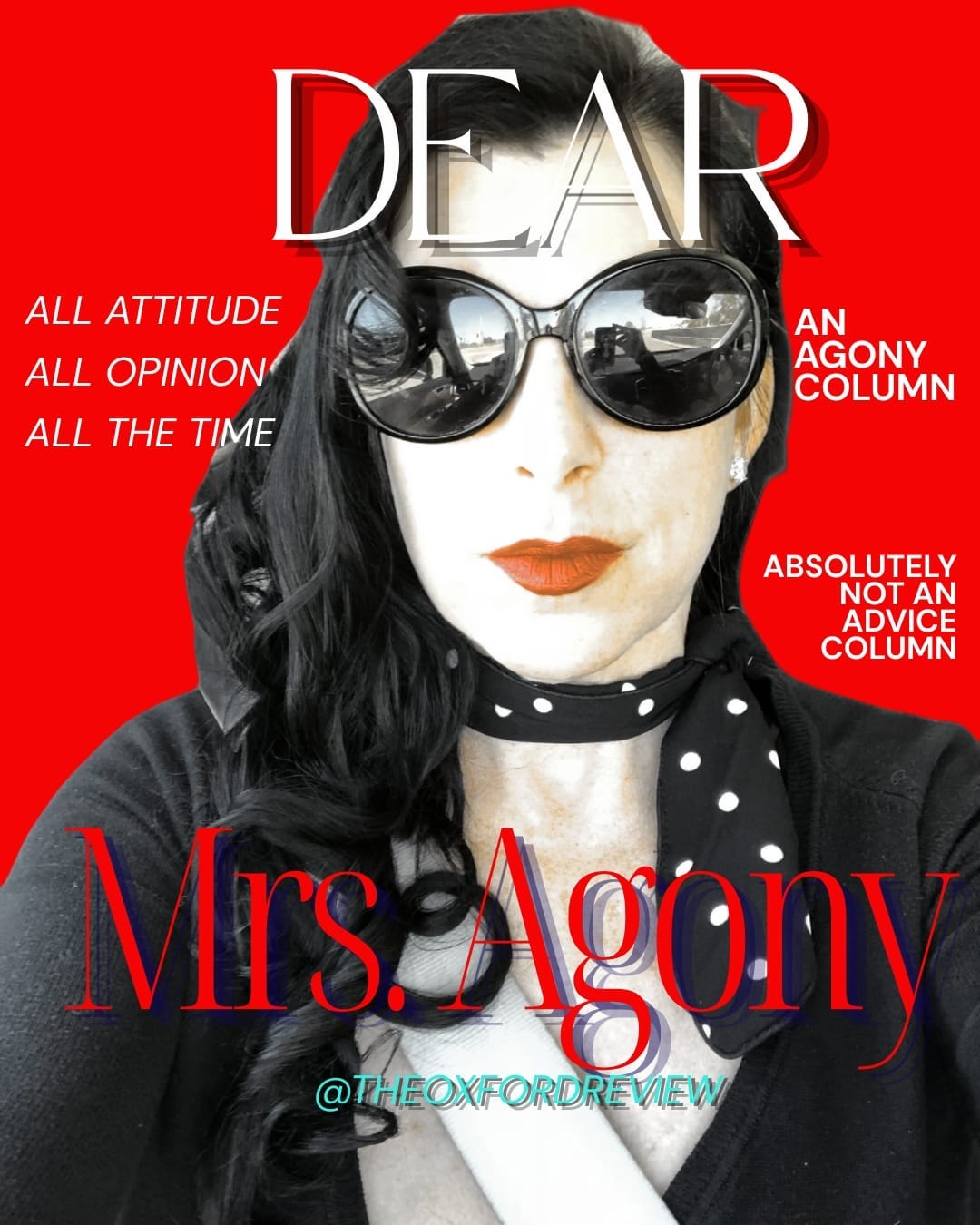
5. Ha, ha, I have exposed that Bella is secretly the author of Mrs. Agony!
Well, darling, I really hate to break the suspicious little bubble you’re so comfortably snuggled into, but this is no secret.
I am ABSOLUTELY Mrs. Agony! The resemblance is not a casting faux pas.
The column is my creation! I hadn’t troubled myself with a moustache or a disguise, darling.
If I were inventing a secret author, I would hope I would be more clever than to use my own photograph.
You don’t have satire in the Bronx any more, I take it?
For this silly little epiphany, I will give you a pass because agony columns may seem esoteric to Americans, and culturally, perhaps the play on words does not translate in the US. Mrs. Agony is a satirical take on the agony column. It is a satire, darling. Allegedly. (Deal with it.)

6. You are ABSOLUTELY CORRECT; Patty Porker is a pseudonym.
And remember, it is satire! That stuff you don’t have in the Bronx.
I am aghast that anyone could have figured out that Patty Porker is a not, in fact, a forty-year-old housewife from Leeds. You must be endowed with special gifts of perception.
She had some very clever lines which—with her permission—I happily cut and pasted into the column.
And thank you for reminding me. Unfortunately, I have a backlog to transcribe!
You see, husbands regularly send in observations they would like published and identities they would very much prefer to be withheld. Some possess the elementary instinct of self-preservation. Why, that, coupled with sheer terror of their wives, requires anonymity. Others sign their full names, which I find to be a bit reckless if they value their life or their marriage.
Still, a good story deserves an audience, and I, too, am a writer, after all.
(See our call for letters at the end of each Mrs. Agony Column—we’ve been advertising the conspiracy.)

7. The Glamour in Writing begs no question!
And shame on you for not even researching this one!
Glamour in Writing is absolutely real and so easily verified it is sad that it was called into question at all.
As a matter of fact, we challenge you to reach out to each and every one of our calendar photo winners. They’re all tagged in individual posts, and they, too, have already been paid for their photos.

8. Do the editors at The Oxford Review really have credentials?
We do have a masthead, darling. It is not a mood board.
Of course, we have pedigree. Our editors have graduated from either Oxford, Harvard or both. Some have been instructors at the very same universities.
9.On LLM's or AI
And your tired suggestion that any of my work might have potentially been written by an advanced LLM or AI to avoid detection betrays a lack of even basic understanding of Occam’s razor or the fundamentals of deductive reasoning. My dear Holmes, there may be another possibility. You nearly peed yourself because your name magically appeared in our post.
I use coding to make people’s names show up in my articles. Thus, I must be guilty! Yes, I have practical intelligence—not artificial. One should try it occasionally.
HERE IS THE FORMULA IF YOU WANT TO TRY IT:
It is an easy trick of putting two percentage signs, the word ‘first’, then underscore, the word ‘last’, then two more percentage signs. The person’s name will show up like so: The Oxford Review. Ignorance is astounding, and when it is misdirected, it is particularly annoying.
Aside from this wizardry of coding that I’ve conjured to make my posts more clever, let’s deal with your AI question!
Whilst I am flattered that you find my writing grammatically flawless, my rather Victorian approach to writing has generally protected me from such accusations.
For this reason, I ask: Are you mad?
There is not one AI clever enough to be as gloriously funny as I am whilst still making spelling mistakes.
Plus, just Pangram it, darling! You will see—it is all just me!
10. Finally. Did she really interview Twiggy in New York?
Oh, dear God. Just look up the damn pictures of us together, will you?
The laziness reads ‘I live in mum’s basement’ guerrilla journalism, where the author is too tired to move his finger across the trackpad so that they can competently cast aspersion with evidence. Evidence. How novel, right?
Oh, look! Could that possibly be a picture of Twiggy in a private room at the Bottino Restaurant in Chelsea with Bella, the editor of The Oxford Review?
Call the constabulary; she must have been abducted!

Finally, might I suggest that you stop being a Killjoy Karen or a Bitchy Bob and loosen the collar a little? It is so clearly cutting off circulation.
There is some pleasure to be had with The Oxford Review. You can start getting pissy if we ever ask for money to ‘help you with your writing’ or if we ever ‘charge you for submissions’.
I assure you—despite your paranoia—there is no submission invoice waiting at the end of this sentence.
Please expand your repertoire when researching us. The practical distinctions are all available online, and maybe in the future you can even use that LLM you referenced to power your research and give it a little truth, clarity and legitimacy.
I may have flattered you in a personal note, but since you’ve submitted for FREE, I assure you that I’ve gained nothing but a migraine as payment for complimenting your writing.
I have never and would never offer ‘editing services’ for cash. There is no glory in prostituting oneself to critique untamed submissions for £3.00 an hour.
I have real editing to do.
Please put down your cracked monocle and tattered detective notebook and pick up a fountain pen (or a laptop) and get to writing. For some reason, I remain irritatingly convinced that perhaps you can produce something worth publishing.
Until that time, stop being a thorn in the side of a small press and support us, damn it.
And keep writing. It is a little untethered and rough around the edges, but you are damn good at it.
*Remember, you wild dingoes out there, according to Cornell Law School,
‘A writer cannot escape a libel claim simply by placing a tiny disclaimer or retraction at the end of a highly sensationalised article. Legal systems evaluate the natural and ordinary meaning of a text based on how a reasonable reader would consume it.’
*I hope I do not also have to apologise for my British spelling. I await the suggestions with bated breath as it seems that the word ‘investigative’ seems to have taken on a completely new meaning. This is not the Oxnard Review, we try to stay in the bumper rails of British spelling.
Complaints registered with Mrs. Agony please!